

What does technology mean for marketing? Part 4
- In the Loop

- Sep 3, 2020
- 5 min read
As with any new technology, especially complex systems, there are a few pitfalls to watch out for:
The functionality touted during the vendors' sales pitch is more limited than anticipated. Thought that the system tracked interactions from the website to the call center, but all it does is prompt the agent to ask the customer "Where did you hear about us"? Yeah, make sure you understand exactly what each function entails and if you're still not sure ask for a demo.
The trickiest part of the process is the implementation and integration. Popped a text to your whole database with a promotion from last year? Yup, ensure you give yourself enough time to test the platform exhaustively.
Ensure your current workflows are efficient, automating a dysfunctional process won't make it better.
Marketing automation is dependent on a growing, value-driven database. If your database is full of incorrect or outdated information, the automation process will fall flat.
Marketing automation helps you efficiently communicate with your target audience. If, however, your buyer personas are incorrect or your segmentation faulty, you'll be sending irrelevant messages.
Don't just rely on the set of features the vendor touts for his software. It's not just important what the systems does but also how it does it, in other words, how does it solve your problem and then only after that question is answered is it important what the tool looks and functions like.
All righty then, how do you choose a platform and what steps do you need to take to implement successfully?
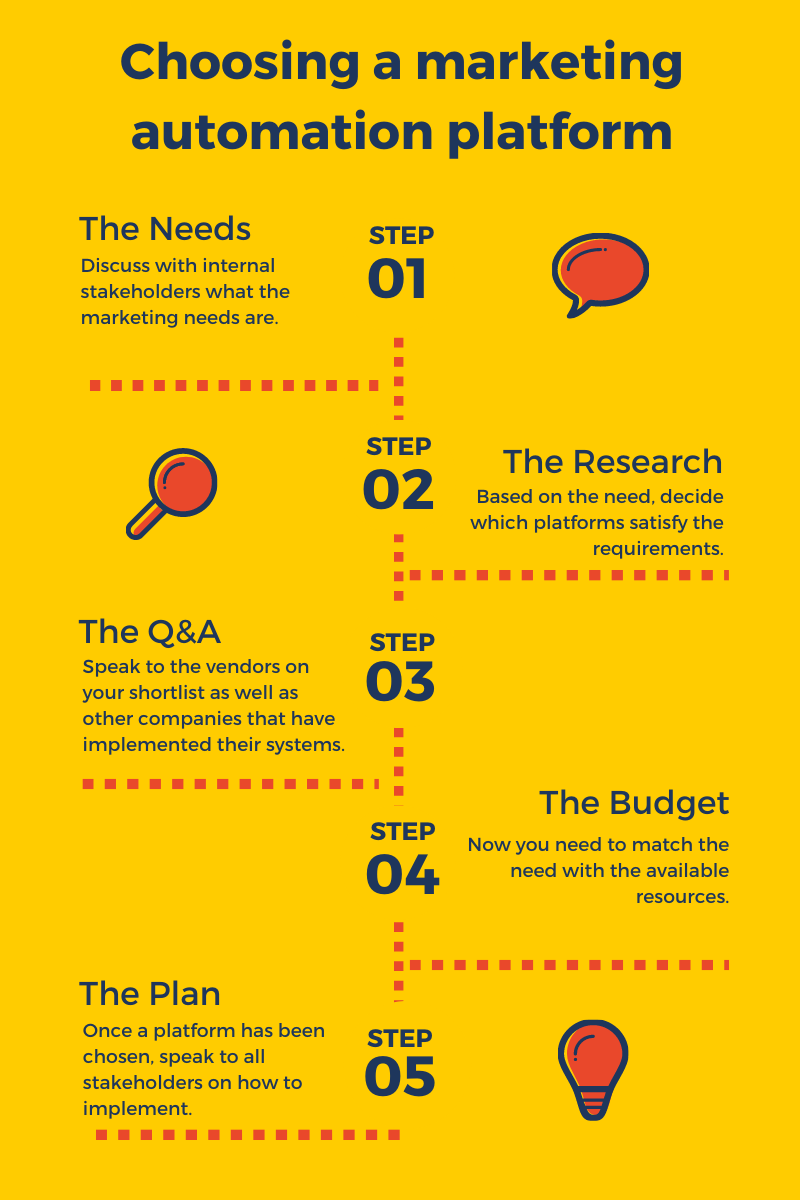
Determine the need. If you spoke to the guys in Sales, what would they say to a doubling in the volume of leads? Do they have the resources to effectively serve new customers? Is the current IT infrastructure capable of supporting a marketing automation platform (think bandwidth, concurrent users, database security, network stability, remote capabilities)? Do you have enough stock on hand and can you increase manufacturing volumes? Will you need additional people in your call center? Make sure that every department is involved as they have a unique perspective on their contribution to the business and will have differing views on what the impact will be of a successful marketing platform implementation.
Once you are satisfied that the business can handle an instantaneous or accelerating increase in business, interpret those needs as well as taking into consideration the alignment with business goals and research the various marketing automation platforms available. Have a list for critical needs and a list for "nice-to-have's" and shortlist the platforms where you tick the most boxes.
Only once you have found one or two platforms where you've ticked all or most of the boxes, do you start looking at cost. I know this might sound a little counterproductive, what if the ideal solution is way beyond the means of the business? "I might waste a lot of time identifying the right solution only to find we can't afford it!". That might happen, and if it does (or even if it doesn't), you have a few options:
Speak to the vendor and explain the situation. Ask for a demo with live or archived data to present to your decision makers so they can see the value of the platform first hand, and then negotiate for a larger budget.
Many vendors offer a time trial where the full functionality of the product can be tested (usually for 30 days). Use this opportunity to make a case for the platform by testing campaigns based on your current promotions and measuring sales and feedback, and then negotiate for a larger budget.
Bottom line, negotiate for a larger budget if your current one won't cover the cost. This might sound a bit arrogant, but if you've done your due diligence and you've got buy-in from the rest of the business, then why settle for a product that doesn't address the agreed upon needs or completely forego the benefits of having a platform at all? And always, always test a platform before you buy.
Budget approved? Great. Now get the vendor around a table with role players from other departments and trash out any remaining questions or concerns. Make sure you understand even the non-marketing related issues such as how the SLA (service level agreement) is structured, how customisable is the platform, can you export your data if you wanted to move to a competitor's platform and so forth.
This next step is normally a doozy, drawing up a plan on how you will implement the software. Make sure you get IT, Sales, Finance and anyone else involved in the sales process in the same room as the vendor and then hash out a project plan of who needs to do what by when. Solid integration is crucial to the success of the automation and you need to spend as much time on this step as necessary to ensure everyone is on the same page.
Test the system. Then test it again. Then test a third time. The one final time. Once more just for good measure and then one last time. Maybe even once more. Test the system. Make them small campaigns targeted at a small subset of your customers with a very specific promotion that's ring fenced from your other activities. This'll help with the next step.
Once your test campaigns are out in the wild, keep a close eye on the process throughout the workflow as well as the results that are being attained. Don't be afraid to contact some of the customers targeted through the campaign (if possible) and get their feedback directly. It could be that your customers can help you further refine the process by highlighting the good and bad of their experience.
Once the test campaigns have run their course, compile a feedback report that contains what worked and what didn't and share it with all the departments involved. Work through what didn't work and find solutions with the vendor and internal stakeholders and analyse what worked so you can build on that.
If you ran the test campaign on an off-site instance of the software, now's the time when you fully integrate with your in-house systems. No turning back after this one. Here is also where you need to spend as much time with all the relevant parties to make sure everything works and if you need to repeat step 6 and test everything again, do it.
In any business, large or small, this process is very involved, time-consuming and stressful. With good communication, an open mind to change and the willingness to improve the measurability of your marketing efforts and increase ROI, it will all be more than worth it. Below is a cheat sheet of the process in choosing and implementing a marketing automation process, feel free to use it and add to it to suit your needs.

Whew! Hope you've been finding these posts helpful, stick around as we'll soon start looking at some future technology!
Reinard du Plessis, CEO



Comments